

2x more efficient than traditional sonic toothbrushes
Clinically proven efficiency: 2x less dental plaque in 30 days.
- Significant 48% reduction in dental plaque after 30 days of use. (1)
- Y-Brush delivers similar efficiency to a leading sonic toothbrush, in half the brushing time.
- 100% of users saw an improvement in their oral hygiene, with a lower plaque index.
(1) Average reduction observed compared with baseline, Day 0, after 30 days of twice-daily Y-Brush use.
Randomized, comparative, single-blind clinical study conducted under dental supervision on 110 subjects, including 55 in the Y-Brush group, over 30 days with twice-daily brushing. Comparison of plaque index versus Day 0 and versus use of the Philips Sonicare 3100 toothbrush for 2 minutes. Palubicka et al., Journal of Dentistry and Oral Health , 2025.

Y-Brush sonic toothbrush versus classic brushing
The Y-Brush sonic toothbrush is a sonic electric toothbrush made in France and designed to brush every surface of all teeth at the same time, autonomously in just 20 seconds. It consists of a handle generating sonic vibrations and a highly flexible Y-shaped brush head that adapts to different jaw shapes and is lined with soft nylon bristles.
Designed in collaboration with dentists, the device imitates the Bass method recommended by healthcare professionals. It aims to clean teeth precisely at a 45-degree angle, as well as the gums and the junction between the two, where bacteria responsible for gingivitis and periodontitis can accumulate. The length and fineness of Y-Brush’s nylon filaments make it possible to reach interdental spaces, the gingival sulcus and the gums. Soft and rounded at the tip, the bristles do not damage the gums or tooth enamel.
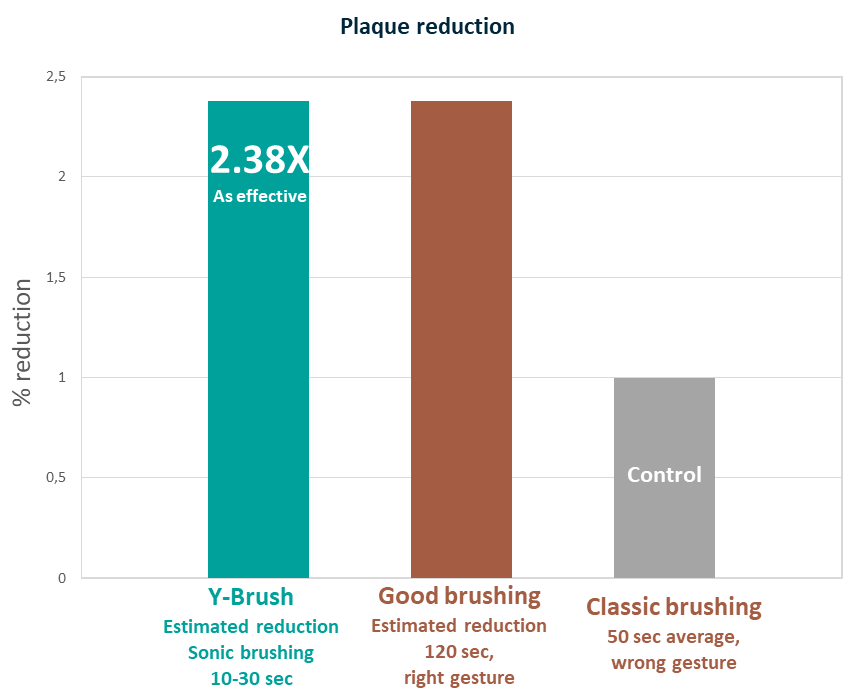
Independent clinical tests demonstrate the equivalence between Y-Brush sonic technology at 20 seconds and well-executed brushing at 2 minutes with perfect technique, meaning greater efficiency compared with classic brushing at 45–50 seconds with average technique.
(Sources: IPSOS oral care survey 2012 / clinical study conducted by an independent organization in 2021).
Sonic toothbrush versus oscillating-rotating toothbrush: gum aggression
Oscillating-rotating toothbrushes are electric toothbrushes with a round head that rotates thanks to the handle mechanism.
This technology is older and less innovative than sonic technology. On battery, they offer around one week of autonomy, compared with several weeks or months for sonic toothbrushes. Clinical testing has shown that sonic toothbrushes reduce dental plaque more effectively than oscillating-rotating toothbrushes.
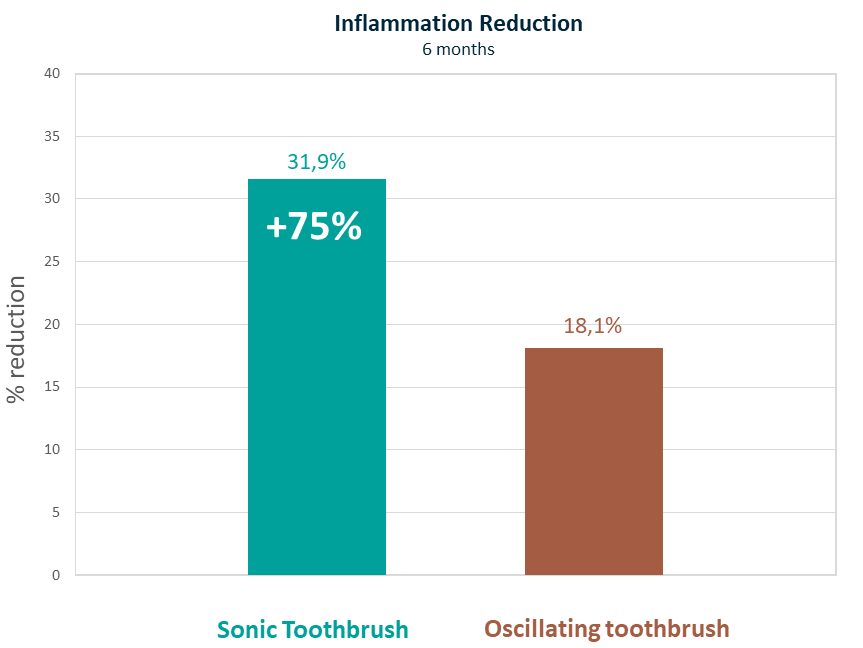
In addition, gum inflammation is reduced much more with sonic technology than with oscillating-rotating technology — 31.9% sonic vs 18% oscillating-rotating (PubMed). Other studies show that sonic technology removes up to 20% more dental plaque compared with oscillating-rotating brushes and protects the gums without damaging them; the 30-day gingival index has been shown to be almost twice as good compared with an oscillating-rotating toothbrush (PubMed).
Simplified daily brushing with no compromise on performance
The study proved there is no difference in efficiency between Y-Brush and a leading sonic toothbrush on the market2,3,7. You change toothbrush, not results.
The problem with silicone bristles
Previous studies showed that automatic silicone toothbrushes were ineffective. Their thick nubs slide over plaque without mechanically abrading it, and do not properly clean interdental spaces or the gingival sulcus.
35,000 nylon filaments
Y-Brush innovates by using genuine soft nylon bristles, the same material recommended by dentists. This high density enables a real, penetrating mechanical brushing action on all teeth in the same arch.
45° angle, Bass method
The bristles are positioned at a precise 45-degree angle toward the gums. Combined with sonic vibrations, this automatically reproduces the modified Bass technique, recognized by the dental profession as one of the most effective brushing methods.
