Sommaire de l'article+
As we age, the mouth requires special attention. Many seniors retain a few natural teeth while wearing a removable prosthesis, also called dentures or a removable dental appliance. These two situations require different but complementary care. This guide is intended for older people and their caregivers, to help maintain a healthy mouth.
key takeaways
- Remaining natural teeth should be brushed gently morning and evening to protect often-sensitive gums.
- Removable prostheses should be cleaned every day, rinsed after meals and left to soak overnight.
- Never use abrasive toothpaste or very hot water on dentures.
- Good oral care helps prevent fungal infections, bad breath and gum pain.
- Teeth and prostheses require two care routines carried out in parallel.
Teeth and prostheses: two complementary care routines
In older people, the mouth often includes weakened natural teeth and a prosthesis. Neglecting either one weakens the whole: a poorly brushed tooth deteriorates, while poorly cleaned dentures encourage plaque and fungal growth. The solution is a simple routine repeated every day.
Gently caring for remaining natural teeth
The remaining teeth deserve thorough but gentle brushing. With age, the gums recede and the tooth necks become sensitive; brushing too hard can cause bleeding. Sonic technology helps: it cleans through rapid vibrations rather than vigorous scrubbing, which is gentler on seniors' sensitive gums.
The Y-Brush sonic toothbrush brushes both sides of the teeth at the same time thanks to its mouthpiece shape, in about ten seconds per jaw. According to tests conducted by Y-Brush, it is 2× more efficient than traditional electric toothbrushes on natural teeth, a real advantage when dexterity declines. For the entry-level model, see the Y-Brush Essential sonic toothbrush.

Rejoignez le club !
Obtenez des conseils personnalisés pour une meilleure hygiène dentaire
This efficiency gain concerns brushing the remaining natural teeth, not cleaning the prosthesis, which follows different rules.
Cleaning removable dentures, step by step
Cleaning dentures follows its own logic. Here is the daily routine:
- Remove the prosthesis and rinse it with lukewarm water after each meal to remove residue.
- Brush it once or twice a day with a dedicated brush and mild soap or a specific cleaner, over a sink filled with water to prevent breakage.
- Soak it overnight in a glass of water or a cleaning solution so that it does not become deformed.
- Rinse it thoroughly before putting it back in your mouth in the morning.
Two mistakes should be avoided: using abrasive toothpaste, which scratches the resin and allows bacteria to collect there, and immersing the prosthesis in very hot water, which deforms it.
Sensitive gums, dry mouth and everyday comfort
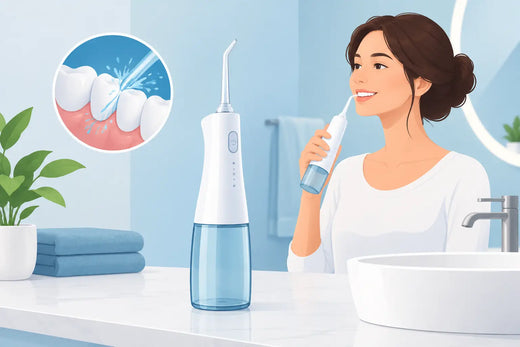
Once the dentures have been removed in the evening, it is helpful to gently massage the gums and tongue with a very soft brush or a damp compress. Dry mouth, which is common with age and certain medications, can be relieved by drinking water regularly. A water flosser can also help rinse hard-to-reach areas around the remaining teeth; see the Hydro Go water flosser with tongue scraper.
Caregivers and life in care facilities
For a dependent loved one or someone living in a nursing home, oral care is an essential part of daily care, just like washing. Caregivers benefit from choosing quick and safe techniques. As confirmed by the clinical studies, the Y-Brush is 2× more efficient than traditional electric toothbrushes, making it safer for a third party to clean natural teeth. To equip a facility or a loved one losing their independence, discover the oral hygiene selection for nursing homes.
How should dentures be cleaned daily?
Rinse the prosthesis after every meal, brush it once or twice a day with a dedicated brush and a mild cleaner, then leave it to soak overnight in water or a suitable solution.
Can regular toothpaste be used on dentures?
No, it is best to avoid abrasive toothpastes. Their microparticles scratch the resin of the removable dental appliance and create areas where bacteria can cling. Use mild soap or a cleaner designed for prostheses instead.
Should dentures be removed at night?
Yes, in most cases. Removing dentures at night allows the gums to breathe and reduces the risk of fungal infections. This is also a good opportunity to soak them, never in very hot water, which would deform them.
How should natural teeth be brushed when the gums are sensitive?
Use soft bristles and a light touch. A sonic toothbrush cleans through vibrations rather than firm scrubbing, which is gentler on fragile gums. According to tests conducted by Y-Brush, the Y-Brush is 2× more efficient than traditional electric toothbrushes on natural teeth.
How often should a removable dental appliance be cared for?
Every day. Rinsing after meals, daily brushing and overnight soaking are enough to keep the prosthesis clean and odor-free. Regular dental checkups verify its fit.
Is a sonic toothbrush suitable for older people?
Yes, it is particularly well suited. Its Y shape brushes both sides of the teeth at the same time, reducing the effort and brushing time when dexterity declines and making care provided by a caregiver easier.