Sommaire de l'article+
Taking care of the mouth of an elderly loved one who can no longer brush their teeth alone is one of the most delicate forms of assistance. For a dependent or bedridden person, brushing becomes genuine care, essential to both their comfort and their health. This guide is intended to help caregivers maintain the dental hygiene of a dependent elderly person safely.
key points to remember
- Position the person semi-upright, with their head tilted forward, never lying flat: this is the first protection against choking.
- Position yourself to the side or behind the face, so you can see inside the mouth and keep your movements steady.
- Aim for short, gentle and guided brushing: a clean mouth is better than perfect care that exhausts your loved one.
- Equipment that cleans the entire jaw in around twenty seconds makes care easier for a person who is not very cooperative.
Why dental hygiene is important for a dependent person
With the loss of autonomy, the mouth quickly becomes more fragile: saliva production decreases, often because of medication, which promotes plaque, cavities and inflamed gums. Poorly maintained oral health becomes painful and can lead to infections.
The risk most closely monitored in a bedridden person is choking, when liquids enter the airways and cause aspiration pneumonia. Brushing is therefore not merely a matter of comfort, but a preventive measure that must be adapted to a loved one who does not always cooperate.
Positioning the person correctly before care
Positioning determines brushing safety. Raise the bed or chair to a semi-upright position, support the head with a pillow and tilt it forward: this allows water and saliva to flow toward the front of the mouth, not toward the throat. As the caregiver, stand to the side or behind the person, at face height, so you can see without straining their neck.

Rejoignez le club !
Obtenez des conseils personnalisés pour une meilleure hygiène dentaire
Tell the person about each movement before making it, then gather the equipment: a suitable toothbrush, a little toothpaste, a glass of water, a kidney dish, gauze pads and, if possible, suction equipment.
How to brush the teeth of a dependent person safely
- Open the mouth gently. Move the lip and cheek aside with a gauze pad; never force tightly clenched jaws, as they often relax on their own.
- Brush a few areas at a time. The Y-shaped head of the Y-Brush covers the upper and lower teeth of a jaw at the same time, limiting the number of movements required.
- Keep it brief. Guided brushing for around twenty seconds per jaw is much less tiring for your loved one than a long manual brushing.
- Take breaks. Allow the person to swallow or spit between areas; if they cough, stop and sit them more upright.
Oral care for a bedridden person: rinsing and choking
For a bedridden person, rinsing is the most sensitive stage. Avoid large sips with the head tilted backward: offer small amounts of water, or moisten the mouth with a gauze pad while keeping the head tilted forward. If the person cannot spit independently, gentle suction or regular wiping removes excess liquid.
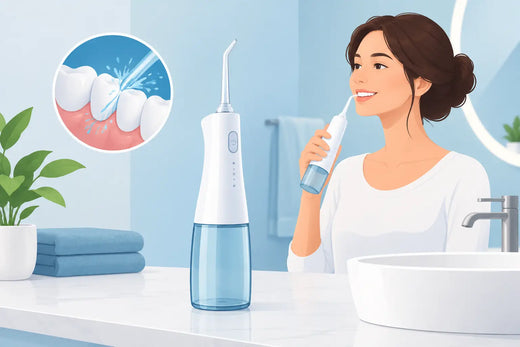
A low-pressure water flosser, such as the Hydro Go water flosser with tongue scraper, loosens residue without rubbing. When caring for a loved one who is not very cooperative, never turn care into a battle of wills: partial cleaning completed calmly and repeated often is better than forced brushing.
What equipment can make caregiving easier
The right equipment shortens the process and requires little dexterity. The Y-Brush Y-shaped toothbrush was designed for this purpose: its silicone filaments follow both sides of the teeth and brush an entire jaw with a single press, in around twenty seconds. According to tests conducted by Y-Brush, this Y-shaped sonic brushing is 2× more efficient than traditional electric toothbrushes, which require brushing each tooth individually.
A toothbrush with a simple movement
The Y-Brush Essential sonic toothbrush vibrates across the entire jaw, which is useful when the person cannot guide the movement.
Precisely dosed toothpaste
The adult toothpaste adapter applies a thin layer to the Y-shaped head, without excess that could make rinsing more difficult.
To equip home or facility-based care, discover the oral hygiene equipment suitable for nursing homes and dependent people. This performance of Y-shaped brushing, 2× more efficient than traditional electric toothbrushes, is documented in the brand's clinical studies.