Sommaire de l'article+
In nursing homes, oral hygiene directly affects overall health, mealtime comfort, and infection prevention. Yet, due to a lack of time and shared guidelines, oral care often remains inconsistent from one team to another. This guide provides care teams with a clear, realistic, and trackable oral and dental care protocol for nursing homes, designed around the constraints of the facility and the daily tasks performed by nursing assistants.
Key points to remember
- A written protocol sets the frequency, individual equipment, and documentation requirements for each oral care session.
- Brushing morning and evening limits the bacterial load and the risk of aspiration pneumonia.
- Individual equipment for each resident, including a dedicated toothbrush and brush head, eliminates the risk of cross-transmission.
- Dentures should be cleaned separately, after meals, with mild soap and never with boiling water.
- A short, standardized task remains manageable despite staff shortages, provided that teams are trained and care is documented.
Why formalize an oral and dental care protocol in a nursing home
The mouths of dependent older adults become fragile quickly: treatment-related dryness, poorly maintained dentures, sensitive gums, and difficulty spitting or rinsing. A neglected oral cavity becomes a reservoir for bacteria which, once inhaled, can trigger aspiration pneumonia, one of the frequent causes of hospitalization in care facilities. A painful mouth also reduces food intake and promotes malnutrition. Formalizing a protocol transforms a task left to individual initiative into a structured routine, shared among teams and recorded in the care file.
Several French guidelines (UFSBD, regional health agencies, and networks for preventing healthcare-associated infections) recommend including oral and dental hygiene in the facility's care plan. For medical situations involving persistent pain, lesions, bleeding, or unstable dentures, the team always refers the person to their dentist or the coordinating physician: this guide describes an organizational approach, not individualized medical advice.
The protocol steps, day after day
A useful protocol consists of a few repeatable steps, from the day of admission through each daily care session.

Rejoignez le club !
Obtenez des conseils personnalisés pour une meilleure hygiène dentaire
- Assess upon admission. Record the condition of the teeth and gums, the presence of dentures, the level of independence, and any difficulties (resistance, dryness). Updated regularly, this assessment guides the frequency and type of oral care for older adults.
- Position the resident. Seat the resident or slightly elevate their head, ensure good lighting, and explain each step to reduce apprehension.
- Brush morning and evening. Brush at least twice a day with a soft-bristled toothbrush and fluoride toothpaste, plus a moisturizing treatment during the day for dry mouths.
- Clean dentures separately. Remove them after the main meals, brush with mild soap, rinse with cold water, dry, then store in a labeled container.
- Record the care. Note the time, type of care and caregiver on the paper or digital care record to ensure reliable handovers.
Standardize the technique to keep pace
The simpler the technique, the more likely it is to be performed properly. A Y-shaped toothbrush cleans both arches at the same time in around twenty seconds, whereas a complete manual brushing takes several minutes per resident. According to tests conducted by Y-Brush, this sonic technology is 2× more efficient than traditional electric toothbrushes; the data is detailed in the clinical studies. This time saving becomes decisive when every minute per resident counts.
Recommended equipment, resident by resident
The principle is simple: individual, assigned and maintained equipment that never passes from one mouth to another. Find the devices designed for care facilities in the dedicated collection for oral hygiene in nursing homes, together with the guide to oral hygiene in nursing homes.
One toothbrush per resident
The Y-Brush Essential sonic toothbrush is stored with the resident's name and ensures consistent brushing regardless of the caregiver.
A reinforced model
For the busiest units, the Y-Brush Ultra toothbrush offers battery life and power suited to intensive use.
Simplified application
The toothpaste adapter dispenses the right amount onto the Y-shaped head and saves valuable time during care.
Dentures: care in their own right
Removable dentures collect plaque and food debris. They should be removed after main meals, brushed with mild soap rather than abrasive toothpaste, then rinsed with cold water. Boiling water must be avoided: it deforms the resin. At night, the denture should be removed, cleaned and stored dry in a personal, labeled container, never in a shared glass. The mouth itself should still be cleaned even without teeth: the gums, tongue and palate should be massaged with a damp gauze pad.
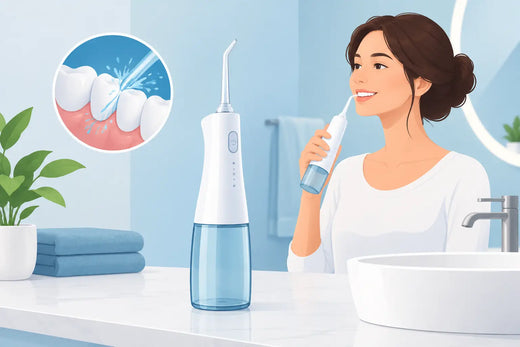
A water flosser with tongue scraper can complement care by dislodging residue around the remaining teeth and freshening the mouths of residents who tolerate it well.
Dry mouth, pain, resistant resident: adapt the action
Some situations require adjusting the protocol without ever abandoning it.
Dry mouth (xerostomia)
Very common during treatment, dry mouth can be relieved with sips of water, a facial mist, saliva substitutes and an emollient on the lips. A moistened mouth is also easier and more comfortable to brush.
The disoriented or resistant resident
When someone resists, a calm approach is best: explain, demonstrate the action and reassure them through contact. If the refusal persists, it is better not to force it and to try again a little later, or ask another caregiver to provide the care. A short action, with brushing taking around twenty seconds, significantly increases the chances that it will be accepted.
Documentation and team coordination
A protocol is only effective if it is documented. A monitoring form, on paper or integrated into the care software, records the time, type of care and caregiver for each resident. This documentation ensures safe handovers between day and night teams, records the care provided and facilitates communication with the treating dentist. Regularity matters more than duration: a short, systematic action provides better protection than long but inconsistent brushing. A device 2× more efficient than traditional electric toothbrushes, as shown by the clinical studies, helps maintain this routine without exhausting caregivers.
Train teams in oral hygiene
Caregiver training is the foundation of the protocol: recognizing a mouth at risk, positioning the resident, adapting the technique for a confused person, and maintaining dentures and toothbrushes. A few minutes of demonstration are enough to standardize practices among nursing assistants, healthcare service agents and nurses. Appointing one oral hygiene lead per unit makes the process sustainable: they update the protocol, support new arrivals and check the traceability of care.